
How do tides work?
Coming on holiday to the Emerald Coast also means experiencing spring tides! You want to make the most of them but don’t really know how tides work? We’ll share all our secrets to help you find the best spots to enjoy this spectacular natural phenomenon and, why not, try your hand at shore fishing! Discover all our tips to get a front-row seat!
What is a tide?
A tide is the rise of the sea (followed by its fall) caused by the combined gravitational pull of the Moon and the Sun. There is a tide approximately every six hours. This means the sea is high and low twice every 24 hours.
And because the Moon returns to the same position relative to the Earth every 24 hours and 50 minutes, the timing of the tides shifts by about 50 minutes later each day.
Spring Tides
The coefficient refers to the tidal range (that is, the difference in water height) between high tide and low tide.
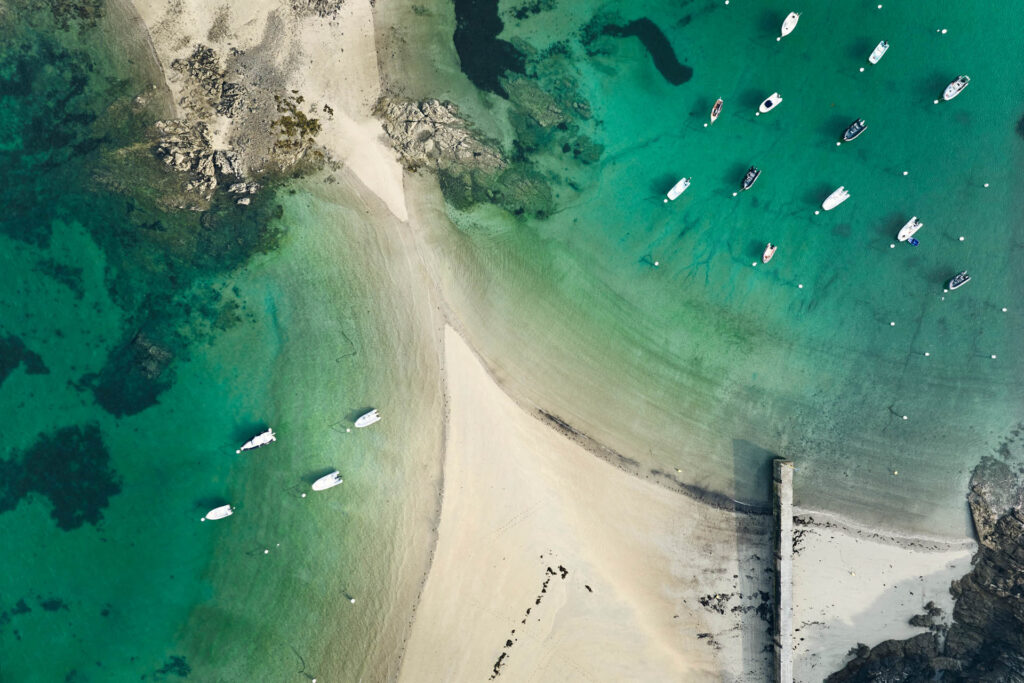
By convention, the SHOM (the French National Hydrographic and Oceanographic Service) has defined spring tides as occurring when the coefficient reaches or exceeds 100. On these days, beaches can be almost completely covered by the sea or, on the contrary, become very extensive, revealing a wider intertidal zone, sometimes exposing hidden treasures or areas that are usually submerged.
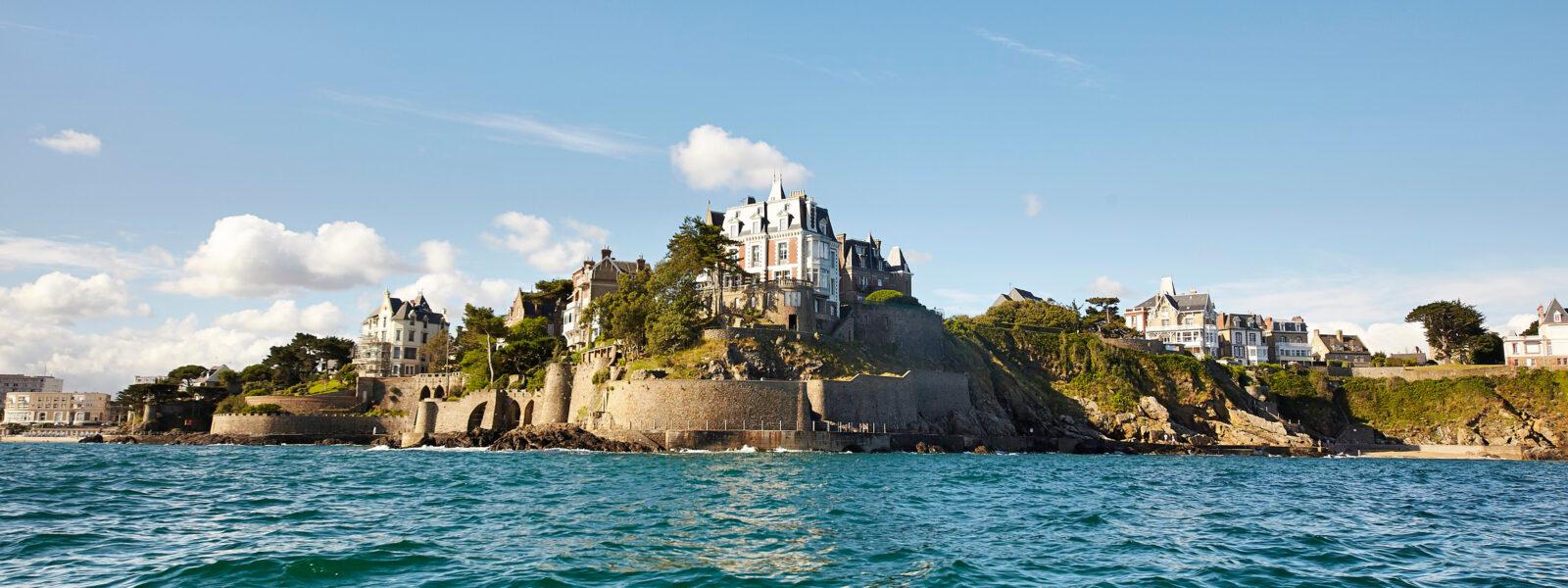
Dinard and its surrounding towns are ideally located at the heart of the Bay of Saint-Malo. This is where some of the largest tides in Europe can be observed, second only to those of the Bay of Mont-Saint-Michel.
When are the next spring tides in 2026?
| From 31/01 to 2/02 – Coef. max 99 | From 8 to 11/11 – Coef. max. 106 |
| From 28/02 to 4/03 – Coef. max. 111 | From 6 to 10/10 – Coef. max. 110 |
| From 28/03 to 1/04 – Coef. max. 114 | From 4 to 8/11 – Coef. max. 106 |
| From 26 to 30/04 – Coef. max. 108 |
Finding the perfect spot to watch the tides
Spring tides are the perfect time to discover breathtaking locations and enjoy the spectacle! Let yourself be amazed by this ever-changing landscape shaped by the rhythm of the tides: the colours and the unique atmosphere that come with it…
A few must-see spots to fully experience the rhythm of the spring tides… where young and old alike can play with the waves – watch out for splashes!
- The Écluse seawall or the Prieuré Beach in Dinard
- The Longchamp seawall in Saint-Lunaire
- Saint-Sieu Beach in Lancieux
Don’t forget: extreme caution is essential!
What about tides in the Rance estuary?
Are you planning to go fishing, hiking, sailing on the Rance, or simply wondering whether tides behave the same way in the estuary? Tides between the sea and the Rance are noticeably offset.
Here’s how to calculate the tidal difference between the sea and the Rance:
- Low tide is generally about 3 hours later than at sea.
- High tide occurs approximately 1.5 to 3 hours later than at sea, depending on the tidal coefficients.
Water levels are also not the same between the sea and the Rance. You can find the official tide times for the Rance on the EDF website: click here.